Ovarian cysts are among the most common gynecological conditions found in women of reproductive and premenopausal age. In most cases, they are functional in nature and may regress spontaneously. However, if a cyst persists, increases in size, causes pain, or poses a risk of complications, treatment becomes necessary. One of the modern minimally invasive treatment methods is ovarian cyst sclerotherapy.
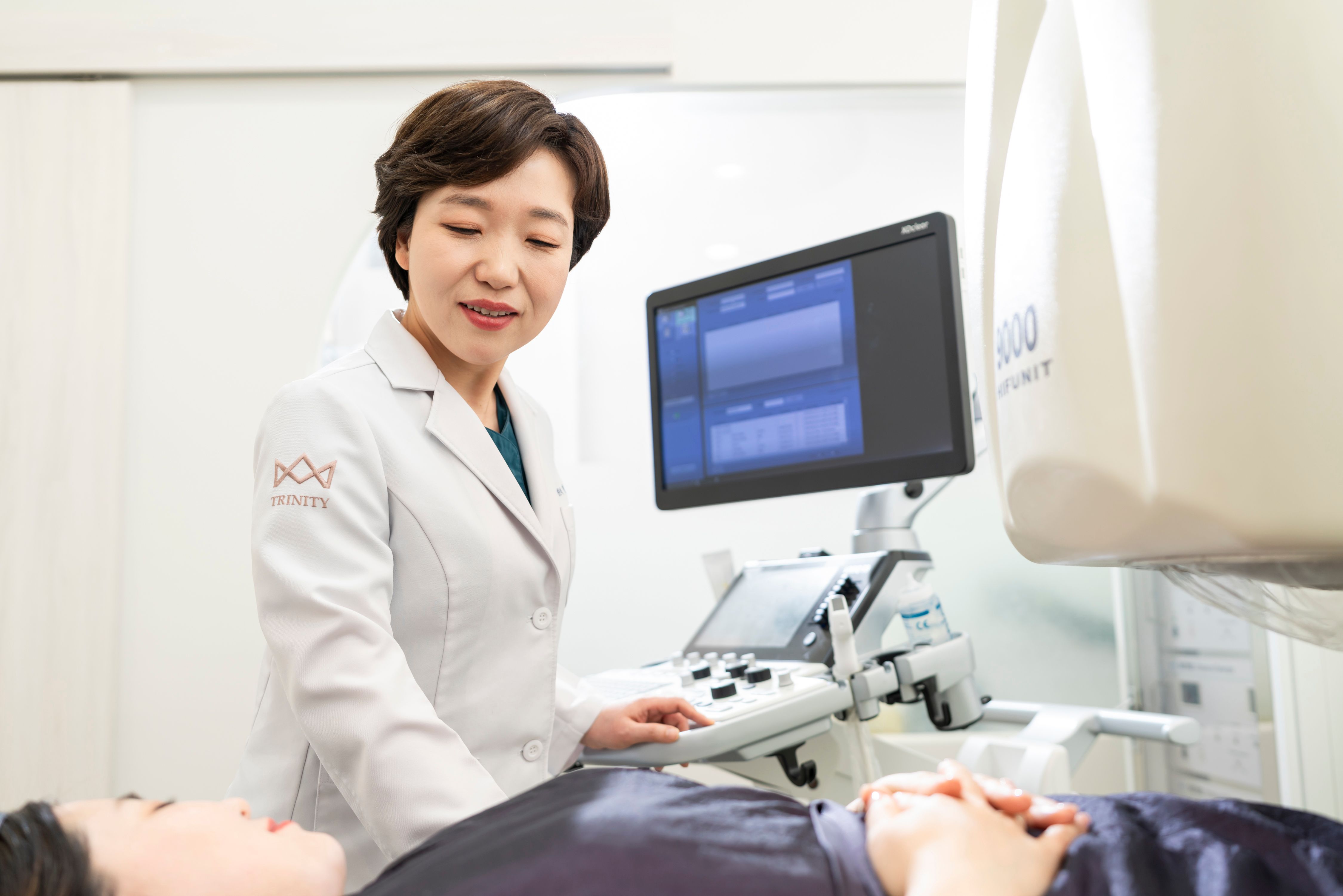
What is sclerotherapy
Sclerotherapy is a procedure in which the contents of a cyst are removed (aspirated) through a thin needle, after which a special substance (a sclerosing agent) is introduced into the cyst cavity. This causes the cyst walls to adhere to each other, preventing the cyst from refilling with fluid.
The procedure is performed under ultrasound guidance, most commonly via a transvaginal approach, and less frequently via a transabdominal approach.
Advantages of sclerotherapy compared with traditional surgical removal of ovarian cysts.
1. Minimal invasiveness
Sclerotherapy is performed via puncture with a thin needle under ultrasound guidance, without incisions or damage to the abdominal wall.
Surgery requires punctures or incisions, even when performed laparoscopically.
2. Preservation of ovarian tissue and ovarian reserve
With sclerotherapy:
ovarian tissue is not excised;
the risk of decreased AMH levels and follicular reserve is minimal.
With surgical cyst removal:
part of the healthy ovarian tissue is inevitably removed or damaged;
this is especially critical for young and nulliparous women.
3. No general anesthesia
Sclerotherapy is performed:
under local anesthesia or sedation.
Surgical intervention:
requires general endotracheal anesthesia;
carries anesthetic risks.
4. Rapid recovery
After sclerotherapy:
the patient can go home the same day;
return to normal activity within 1–2 days.
After surgery:
hospitalization for 1–3 days;
recovery takes 1–3 weeks.
5. Lower risk of adhesions
Sclerotherapy:
does not cause peritoneal injury;
the risk of adhesions is minimal.
After surgery:
there is a risk of adhesion formation, which may affect fertility and cause chronic pain.
6. Lower cost
Sclerotherapy:
does not require an operating room, general anesthesia, or prolonged hospitalization;
is more cost-effective.
7. Possibility of repeat treatment
In case of cyst recurrence:
sclerotherapy can be repeated;
without increasing surgical trauma.
Repeat surgeries:
increase the risk of reduced ovarian function and adhesions.
A research on the decrease in AMH levels in women of reproductive age after laparoscopic (surgical) removal of an ovarian cyst.
The research included 60 women of reproductive age who were scheduled for surgical treatment of benign ovarian cysts. Serum anti-Müllerian hormone (AMH) levels were measured before surgery and at 6 and 24 months postoperatively. Data on reproductive plans and attempts to achieve pregnancy were collected using questionnaires. At the time of enrollment, 45 out of 60 participants reported a desire to become pregnant. After 6 months of follow-up, a statistically significant decrease in AMH levels was observed across the entire group, which continued to progress over the subsequent two years: from 2.7 ng/mL to 2.0 ng/mL and further to 1.1 ng/mL, respectively (p < 0.008), corresponding to an overall reduction of 42.9%.**
Conclusion
Ovarian cyst sclerotherapy is an optimal choice for patients, especially when there is a need to preserve reproductive function, avoid general anesthesia, and shorten the recovery period. At the Trinity Women’s Health Clinic in Seoul, South Korea, we perform ovarian cyst sclerotherapy because our goal is to preserve the function of your ovaries.
References
** HEALTH OF WOMAN. 2016.7(113):147–151